
Community cat guide
What Is Trap Neuter Return (TNR)?
Trap-neuter-return (TNR) is a managed process in which qualified people humanely capture community cats, veterinary professionals sterilise and identify them, and the cats are returned to the same location when they are fit to go back. In Spain, the equivalent framework is commonly called CER: captura, esterilización y retorno.
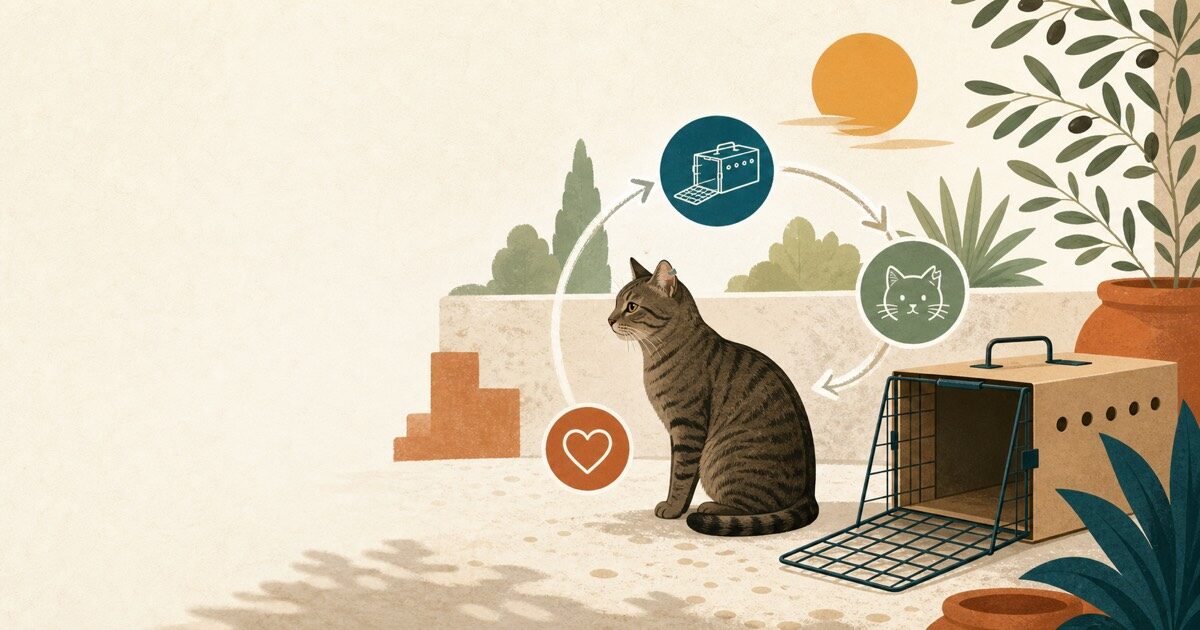
What is trap-neuter-return?
TNR describes a sequence: a community cat is captured with welfare safeguards, checked and treated under veterinary direction, sterilised, visibly identified as already sterilised, and returned to the territory it knows. Ongoing monitoring is part of responsible colony management because carers need to notice new cats and animals that may require professional help.
Spain's Animal Welfare Law uses the term CER for population control within managed feline colonies. The law assigns local authorities responsibility for community-cat management programmes and requires those programmes to cover registration, health planning, sterilisation and trained carers. The consolidated text of Spain's Law 7/2023 is the national legal source.
A community cat is not automatically an abandoned pet, and TNR is not a shortcut around checking for an owner. The Andalusian protocol distinguishes community cats from roaming owned cats and lost animals. The people running an authorised programme should check identification and choose an appropriate pathway for each cat.
How TNR works, step by step
1. Plan through the local programme
Before a trap is set, authorised carers and the responsible authority need a plan. They record cats and colonies, coordinate veterinary capacity and decide who will monitor each trap. Operational records may require a cat's original location, but public pages and social posts should not reveal exact locations, feeding points or carer identities.
2. Capture with welfare safeguards
The Junta de Andalucía's framework protocol for feline colonies says capture must use animal-welfare methods and qualified personnel determined by the competent council. It describes monitored humane traps, secure transport and measures intended to reduce stress. A trap should never be left unattended.
3. Veterinary assessment, care and sterilisation
A veterinary professional checks the cat and decides what care is appropriate. Under the Andalusian framework, the clinical programme includes identification, sterilisation, rabies vaccination, parasite treatment and any other treatment the vet considers necessary. These are professional decisions; this guide does not diagnose a cat or replace veterinary advice.
4. Identification, return and monitoring
The Andalusian protocol uses a visible ear mark to help authorised carers recognise a sterilised cat and avoid capturing the same animal again. Once the cat has recovered as directed by the vet, the normal course is return to the same location where the cat was captured. Relocation is exceptional and requires the legal and welfare process set out by the competent authorities.
Why managed TNR is used
The stated purpose of Spain's community-cat rules is to reduce the population progressively while continuing to protect the cats as companion animals. A managed programme connects sterilisation with registration, veterinary oversight, trained carers, clean feeding arrangements and monitoring for new, ill or injured cats. That wider system is what separates responsible colony management from isolated trapping.
Return matters because community cats are linked to a known territory. Spain's law restricts removal from a colony to defined exceptions, and the Andalusian protocol treats return to the original location as the standard outcome when veterinary and welfare conditions allow it. This is why a well-meaning person should not independently move a cat to another area.
TNR and CER in Estepona
Estepona sits within the national law and the Andalusian framework described above, with the local authority responsible for the municipal programme. A May 2023 notice from Estepona Town Council described collaboration with a local association whose aims included sterilisation awareness, recording stable cat colonies and working with veterinary clinics. The notice is useful local context, but it is not a substitute for confirming today's reporting route with the council.
Circle of Strays is an independent information and storytelling project. It is not the Town Council, a veterinary practice, a shelter or an emergency dispatcher. We do not publish colony coordinates or direct visitors to cats' exact locations. Read more about the community cats associated with Estepona and the safeguards in our welfare and transparency approach.
How people can help safely
- Observe before acting. Note the cat's condition and behaviour from a respectful distance. Do not chase, handle or confine the cat.
- Keep sensitive details private. Share a location only through an appropriate private reporting route, not in public comments or social posts.
- Ask the responsible people. Contact the local authority, an authorised colony carer or an established welfare organisation before feeding, trapping or moving a cat.
- Use professional help for welfare concerns. An injured or unwell cat needs case-specific advice from a veterinary professional or the responsible local service.
- Learn before supporting. You can meet the cats whose details are safe to share, then contact Circle of Strays if your question is about this site's information rather than an emergency response.
Sources and review
This guide draws on Spain's consolidated Law 7/2023, the Junta de Andalucía framework protocol, and the dated Estepona Town Council notice. Local procedures can change, so confirm the current route with the competent authority before acting.
Last reviewed: . General information only; not veterinary or legal advice.